 Skip to content
Advanced Epoxy Flooring Service in Arizona
Meticulous preparation. Premium polyaspartic systems. Concrete floors engineered to shrug off 115° summers—and look installed-yesterday for years.
- Precision in Every Installation
- Top Systems for Arizona's Heat
- Free in person consults
Why Arizona swears by CACTUS CONCRETE COATING Co.

Working with Cactus Coatings was truly exceptional! I usually get frustrated by slow responses from service companies, but Cactus Coatings amazed me by replying to my inquiry in under an hour and quickly scheduling a quote at my home. They patiently answered all my questions, and even after their visit, I had more inquiries which they promptly addressed via text. On installation day, they arrived on time and even helped move our garage fridge inside to create space. They completed the job in just one day and left everything spotless, paying meticulous attention to detail. My partner and I are quite discerning about our home, so those finishing touches really impressed us. We let it cure for three days before moving in heavier items, and we couldn’t be happier with the results. We chose the Stonehenge color/pattern, and it complements our home beautifully.


We had a fantastic experience with Cactus Coatings. I’m sure many of you can relate to the frustration of waiting ages for replies from service providers, but Cactus Coatings responded within the hour to my initial inquiry and quickly scheduled an appointment for a quote at my home. They answered all my questions thoroughly, and even after their visit, I had more questions which they answered promptly via text. On installation day, they arrived on time and even helped move our garage fridge into the house to clear the space. They completed their work within the day and left everything spotless, paying attention to every detail. My husband and I are quite particular about our home, so those finishing touches really matter to us. We let it sit for 3 days before moving heavy items in, and we absolutely love how it looks. We chose the Stonehenge color/pattern, and it’s just perfect for our home.


Epoxy earns its place in concrete flooring because it can bond strongly, build thickness, accept decorative finishes, and create a continuous surface. None of those strengths matter, though, when the concrete underneath receives poor preparation.
Cactus Concrete Coatings Company installs Epoxy Flooring in Arizona by treating the resin as one part of a complete floor system. The slab condition comes first. Exposure and room use come next. Then the coating build can be chosen around what that floor actually needs. This matters in Arizona, where strong UV exposure can make traditional epoxy a poor choice as the final exposed layer in some spaces.

Epoxy Needs a Real Job to Do, and Prep Controls the Bond
“Epoxy flooring” covers solid-color finishes, flake systems built over an epoxy base, and metallic floors using pigmented epoxy for commercial builds where epoxy works as a layer under something else entirely.
That range is exactly why epoxy stays so useful. Instead of asking whether epoxy is good or bad, the better question is what job it’s actually doing in the system.
It’s excellent for bonding and gives installers real working time, which is why an epoxy base paired with a UV-stable polyaspartic topcoat is the go-to combo among Phoenix installers wherever real sun exposure is in play. The complete build matters far more than whatever’s printed on one bucket.
None of that works without a real mechanical bond to the slab, and cleaning alone never creates that.
Diamond grinding is what strips away the weak surface layer that would otherwise sabotage adhesion, along with any old paint, prior coatings, or contamination sitting on the surface.
Ask around and installers agree on this almost without exception: grinding beats acid etching for any epoxy job worth doing right. Cracks and damage need evaluating at this stage too, though repairs shouldn’t be sold as a guarantee that the slab will never move again.
Preparation’s job is giving the coating the best possible surface to bond to; it can’t change what the underlying concrete actually is.
Moisture Risks the Slab & Epoxy's Range of Looks
Desert air says nothing about what’s happening inside the slab; moisture vapor can still move through concrete and build pressure under a coating that can’t breathe, leading to bubbling, whitening, or delamination. One epoxy failure showed peeling near an opening with white efflorescence visible underneath, and experienced installers pointed straight to moisture movement as the likely cause.
That’s why slab history matters so much; older construction, missing vapor barriers, nearby irrigation, past moisture issues, or unexplained coating failures should all raise flags before anything new goes down.
Cactus Concrete Coatings Company treats these as real variables. A slab that looks dry and a slab that actually is dry aren’t always the same thing.
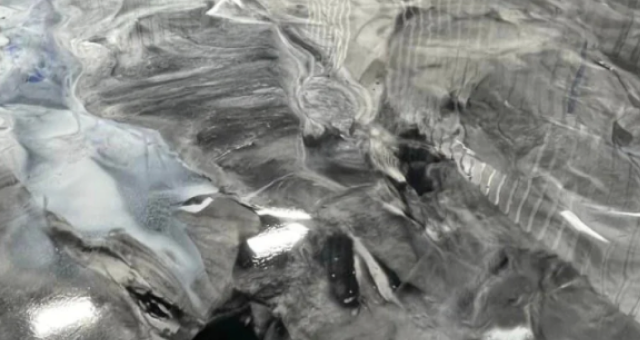
Beyond performance, epoxy also covers a wide range of finished looks. Solid-color systems give a clean, uniform surface, decorative flakes add texture and visual variety when broadcast into the coating, and metallic epoxy uses pigment suspended in the resin to create flowing movement instead of a repeating chip pattern. That range gives owners real control over how much the floor stands out.
A garage might call for full flake coverage, a showroom might justify a more expressive metallic finish, and a commercial work area often prioritizes function over visual complexity. Arizona flooring providers commonly offer all three directions, solid, flake, and metallic, for exactly this reason.

Cure Timing Under Arizona Heat
Epoxy doesn’t become fully usable the moment it feels dry to the touch, and cure windows vary a lot between products. Arizona heat adds its own wrinkle, since higher temperatures shorten working time during application, forcing installers to move faster through mixing, spreading, and finishing.
That matters even more on large floors, where keeping a consistent wet edge across the whole surface is critical. A product that cures too fast for the conditions becomes hard to control, while a slower-curing system extends how long the space stays out of use.
That’s another reason the system should be chosen around the actual project rather than defaulting to whatever cures fastest; installation timing and long-term performance have to work together.
The strongest Arizona systems involve more than epoxy alone. A properly ground slab might take an epoxy or similar base layer, decorative flake for the finish pattern, and a UV-stable polyaspartic topcoat on top to handle sunlight coming through the garage opening.
Each layer is solving a different problem, which is also why comparing quotes by product name alone can be misleading. One quote might describe a single epoxy coat, while another includes grinding, repairs, a high-build base, decorative flake, and a protective topcoat- very different scopes wearing the same label.
Surface Damage Should Be Fixed Before It Spreads
Bare concrete can release fine surface dust as it wears. That dust does not stay politely on the floor.
It can settle on shelving, packaging, stored goods, lower rack levels, and equipment.
A coated or properly finished concrete surface can make warehouse cleaning more controlled because the slab is no longer functioning like an untreated working surface.
Current Arizona warehouse coating guidance also identifies concrete dust as a recurring issue in active facilities. This becomes especially useful in warehouses where appearance or inventory cleanliness, or routine housekeeping matters.
The floor does not need to look decorative. It needs to support the facility instead of adding another maintenance problem.
Why Choose Cactus Concrete Coatings Company
- Epoxy Is Given a Specific Role
Cactus Concrete Coatings Company does not call every resinous layer epoxy and stop there. The base, decorative layer, and protective coat can each serve different purposes. That makes the specification easier to understand and easier to justify.
- Slab Questions Come Before Color Questions
Color selection is easy. Understanding the concrete requires more attention. Existing coatings, cracks, contamination, moisture history, and surface condition are considered before the decorative direction becomes the main discussion. That keeps the floor from being designed backward.
- Arizona Exposure Changes the Top Layer
An enclosed interior and a sunlit opening should not receive identical coating logic. Cactus Concrete Coatings Company considers UV exposure before deciding what chemistry should remain at the surface. That is especially important in Arizona, where polyaspartic protection is commonly paired with epoxy systems for exposed areas.
Arizona Epoxy Flooring Questions
Does every epoxy floor need diamond grinding first?
Mechanical preparation is the professional standard for many epoxy applications because it creates a physical surface profile for bonding.

Can epoxy fail even when the surface was prepared well?
Yes. Moisture vapor, contamination, weak concrete, incorrect application, or problems between coating layers can still cause failure. A recent case involving peeling and white efflorescence pointed strongly toward moisture beneath the coating.
Will epoxy turn yellow in Arizona sunlight?
Direct sunlight eventually discolors traditional epoxy, which is exactly why Arizona systems in exposed spots usually finish with a UV-stable polyaspartic layer.
Is epoxy or polyaspartic better for my floor?
They perform different jobs well. Epoxy provides useful bonding, build, and decorative flexibility. Polyaspartic offers faster curing and stronger UV stability. Many professional systems use both instead of forcing one chemistry across every layer.
Why do professional epoxy quotes cost more than DIY kits?
Professional scopes may include diamond grinding, coating removal, crack repair, moisture evaluation, commercial-grade resin, decorative layers, and protective topcoats. DIY kits can omit several of those steps, so comparing package prices alone does not compare the same system.
Premium Concrete Coatings
From our home base in Surprise, AZ, Cactus Concrete Coating Company delivers premium epoxy floor installation and concrete coatings across the West Valley and greater Phoenix area. Wherever your slab is, it gets the same meticulous prep, the same elite materials, and a free in-person estimate to start.
Give Every Layer a Reason
A good epoxy floor is not simply a thick layer of resin over concrete. Preparation creates the foundation. Epoxy performs the job it was selected for. Decorative layers shape the appearance.
Protective materials handle the conditions above them. Cactus Concrete Coatings Company can evaluate your slab and build Epoxy Flooring in Arizona around those separate decisions.